Why the Freeflow Was Doomed From the Beginning
For decades, workplace restaurants (then still called canteens) worked like school canteens: one line, one daily menu, one simple rhythm. It wasn’t glamorous, but it matched the reality: a captive audience, a fixed lunch window, and predictable demand. Then choice arrived. Salad bars, soups, multiple mains, desserts, coffee corners. Suddenly the old “everyone in one queue” started to feel wrong. Why should someone who only wants soup stand behind a full-tray meal? And as employees started paying a share of the meal, expectations shifted: lunch needed to feel like an experience, not a school routine.

So the industry borrowed a concept from commercial buffet restaurants: the freeflow. Caterers, companies, kitchen suppliers, and architects largely agreed: let people move freely to what they want, and the restaurant will feel modern and efficient.
The idea was good.
The context wasn’t.
The freeflow assumption that breaks in corporate dining
Commercial buffet restaurants rarely have to serve hundreds (sometimes more than a thousand) guests in less than 90 minutes, with a peak that hits immediately when doors open.
In workplace catering, that peak is not a rounding error—it’s the whole game.
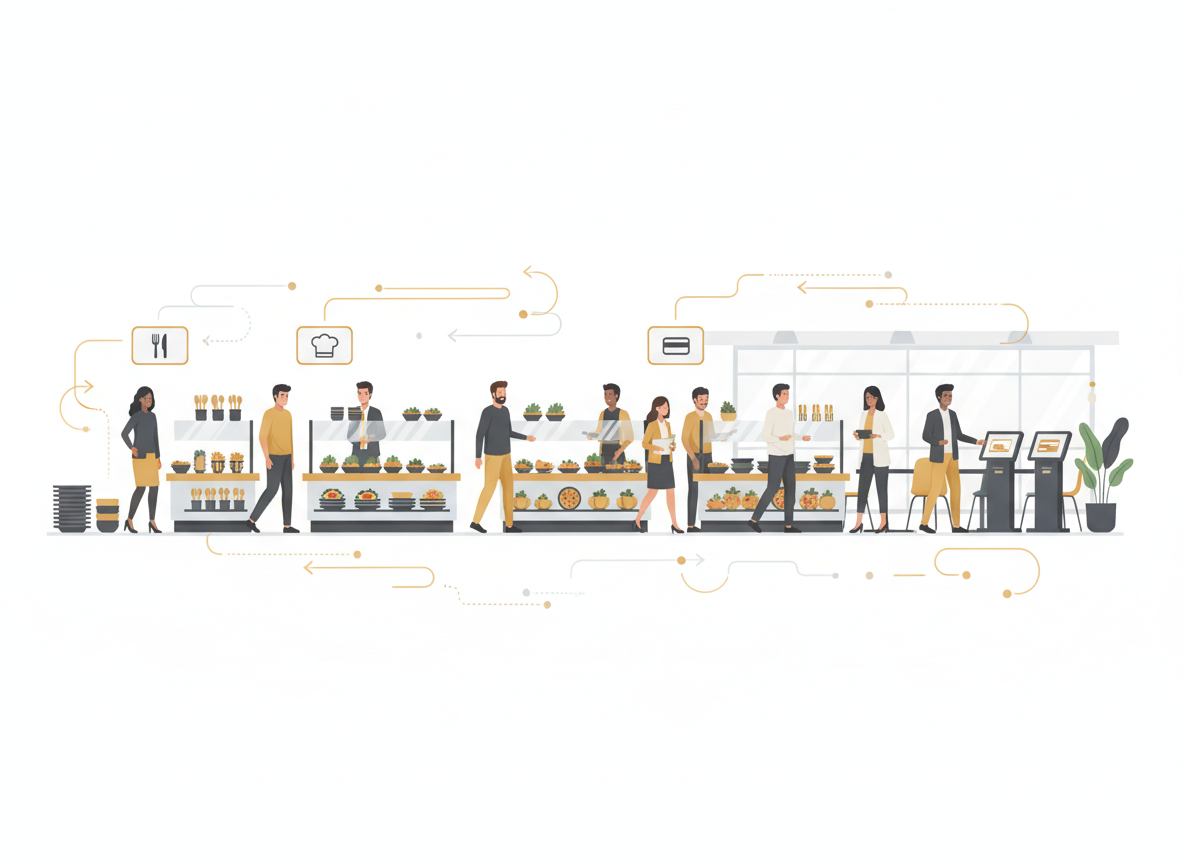
A freeflow that looks elegant on paper can feel like a metro station at rush hour within the first 15 minutes of service. Not because people “don’t understand the concept,” but because the design was imported from a different world:
Commercial restaurants often have a more spread arrival pattern.
Corporate restaurants often have a synchronized arrival pattern (meetings end, shifts change, lunch break starts).
Corporate guests are not browsing for fun—they’re trying to eat and get back.
That’s why I call the typical workplace freeflow a bad good idea: the concept is sound, but the standard execution is structurally mismatched with corporate dynamics.
And yet, we’ve been building the same type of freeflows for decades.
The two design mistakes that create congestion (and frustration)
If you’re designing or renovating a freeflow, here are the two highest-impact things to get right.
1) Avoid stops: congestion is created by “micro-queues”
Every stop in the journey is a chance to create a mini-queue. Stack enough mini-queues together and you don’t get “free movement”—you get gridlock.
A typical freeflow can accidentally force guests into 4–6 separate stops:
Take a tray and cutlery
Get a drink
Take soup
Choose a main course
Pick dessert
Pay
Even if each stop only takes a few seconds, the variability kills you: one person hesitates, another needs help, a third changes their mind, and suddenly the flow collapses.
Design rule: if people need more than 3 stops to complete a full meal, they will usually become part of the congestion.
What to do instead: combine stops intelligently.
Put trays and cutlery directly at the food offer, not as a separate “pre-stop.”
Combine items that logically belong together. For example: why not take soup at the same time the main course is served?
Avoid “spread-out islands” that force people to cross each other’s path.
The goal is simple: simplify the freeflow journey so guests keep moving forward with fewer decision points.
2) Separate fast movers and slow movers
A workplace restaurant serves different “eating missions” at the same time:
Fast movers: grab a sandwich, salad, or quick item and leave.
Slow movers: build a full tray meal, compare options, maybe wait for à la minute service.
When you mix these two groups in one shared path, everyone loses:
Fast movers get stuck slaloming around trays and queues.
Slow movers feel rushed and stressed by high-speed traffic cutting through.
Design rule: create two distinct movement patterns.
A grab-and-go lane (fast, minimal stops, minimal decisions).
A tray-meal lane (more choice, more service steps, but designed to absorb that complexity without blocking others).
This is one of the fastest ways to reduce friction without changing your menu at all.
“Freeflow” isn’t a layout. It’s a system.
A good freeflow is not a pretty plan. It’s a system designed for peak-hour reality.
Before you approve a layout (or blame the team for congestion), you need three inputs.
1) Know who your customers are
Not “employees” in general—your actual profiles.
Different profiles move differently, choose differently, and react differently to queues and change. If you don’t know who you’re serving, you’re guessing how they will move.
2) Know the offer and how it will be served
The same counter behaves very differently depending on service style:
Self-service vs served
À la minute vs buffered
Show cooking vs pre-plated
Staffing levels behind each counter
A freeflow design that works for one service model can fail instantly for another.
3) Create multiple plan options and simulate the flows
Don’t fall in love with the first plan.
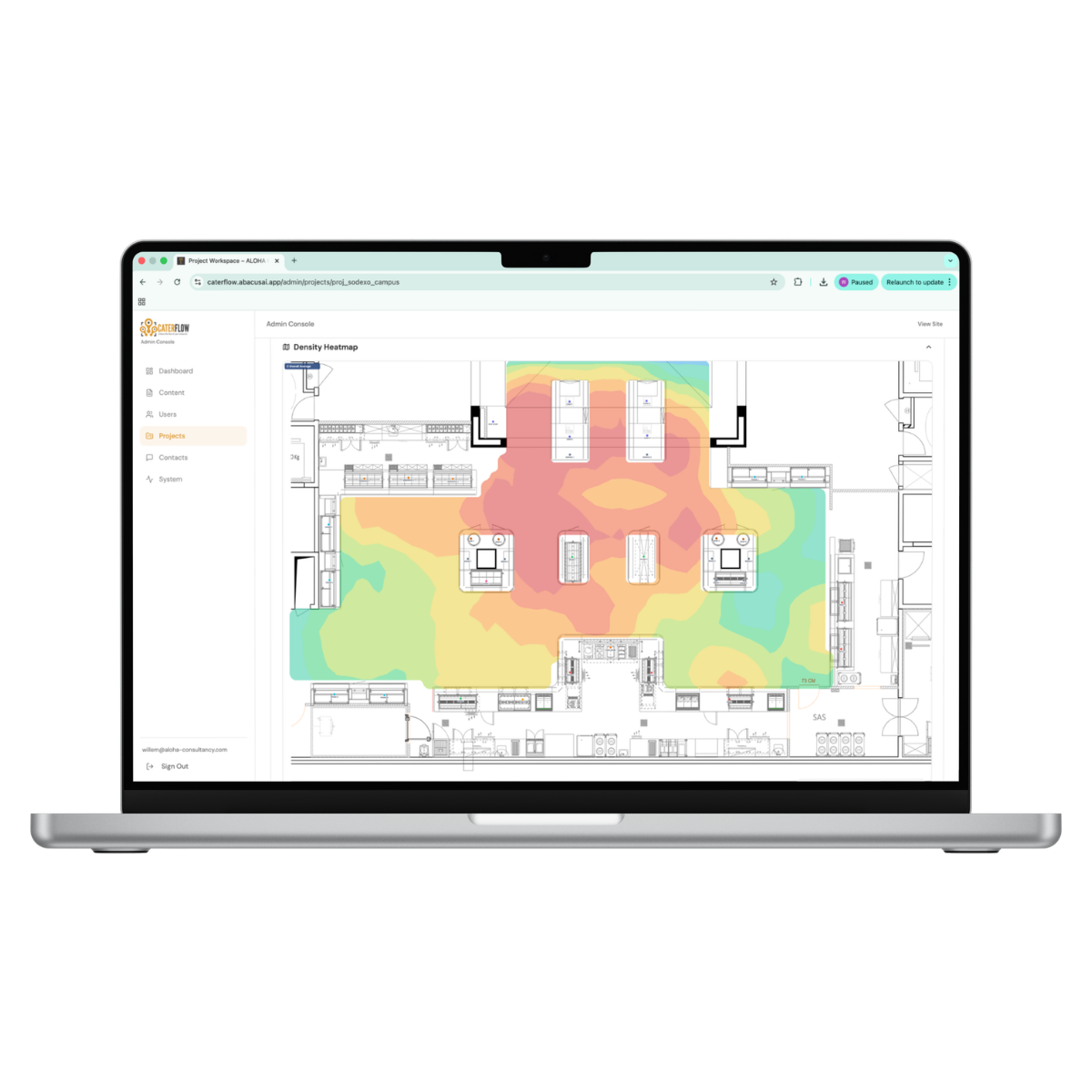
Build options. Stress-test them against peak demand. Simulate where queues will form, where crossing streams will happen, and where “micro-stops” will accumulate.
Then fine-tune until the flow is stable.
The takeaway
The freeflow wasn’t doomed because the idea is wrong.
It was doomed because we copied a commercial buffet concept into a corporate environment with:
extreme peaks
limited time windows
mixed guest missions
and zero tolerance for congestion
If you want a freeflow that actually feels free, start with two basics:
Reduce stops by combining steps at the offer (trays + cutlery where you choose food; soup served with the main if it fits your model).
Separate fast movers from slow movers so each group can move at its natural speed.
See your own restaurant's flow, backed by data
ALOHA CaterFlow simulates your company restaurant so you can cut queues, remove bottlenecks and get a boardroom-ready action plan in 2–3 weeks.
Get started