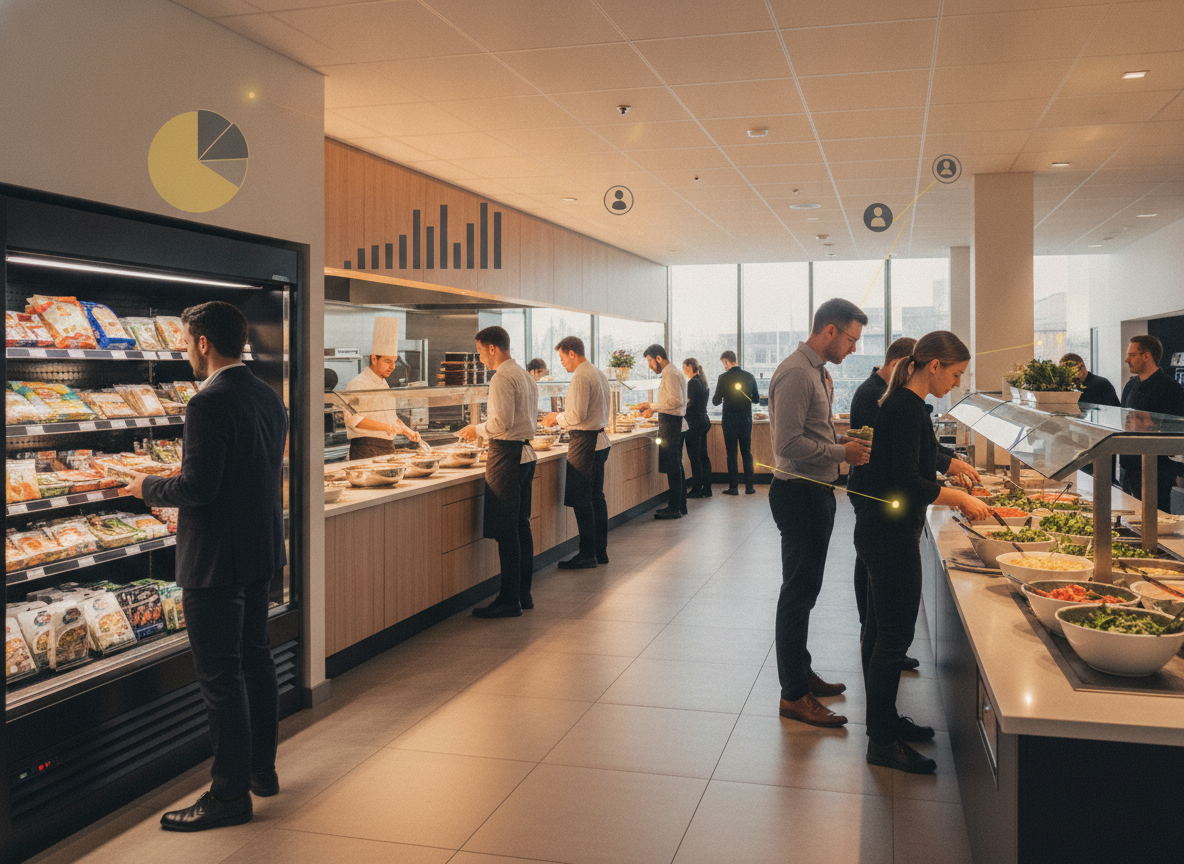
Data matters as much as the food offer
Most workplace catering conversations start with the menu: variety, freshness, price point, dietary options, and the look-and-feel of the counter. Thats logical. Food is the most visible part of the service. But leadership in workplace experience means managing whats less visible and more decisive. Because the catering user experience isnt defined by whats written in a concept note. Its defined by what happens at peak: how long people wait, how predictable the service feels, whether the space absorbs demand without stress, and whether the operation can improve week after week. In other words: the food offer is the promise. Data is the operating system that makes the promise real. If you want catering that employees trust and use and that stakeholders can justify you need to treat data as a core ingredient, not a reporting afterthought.
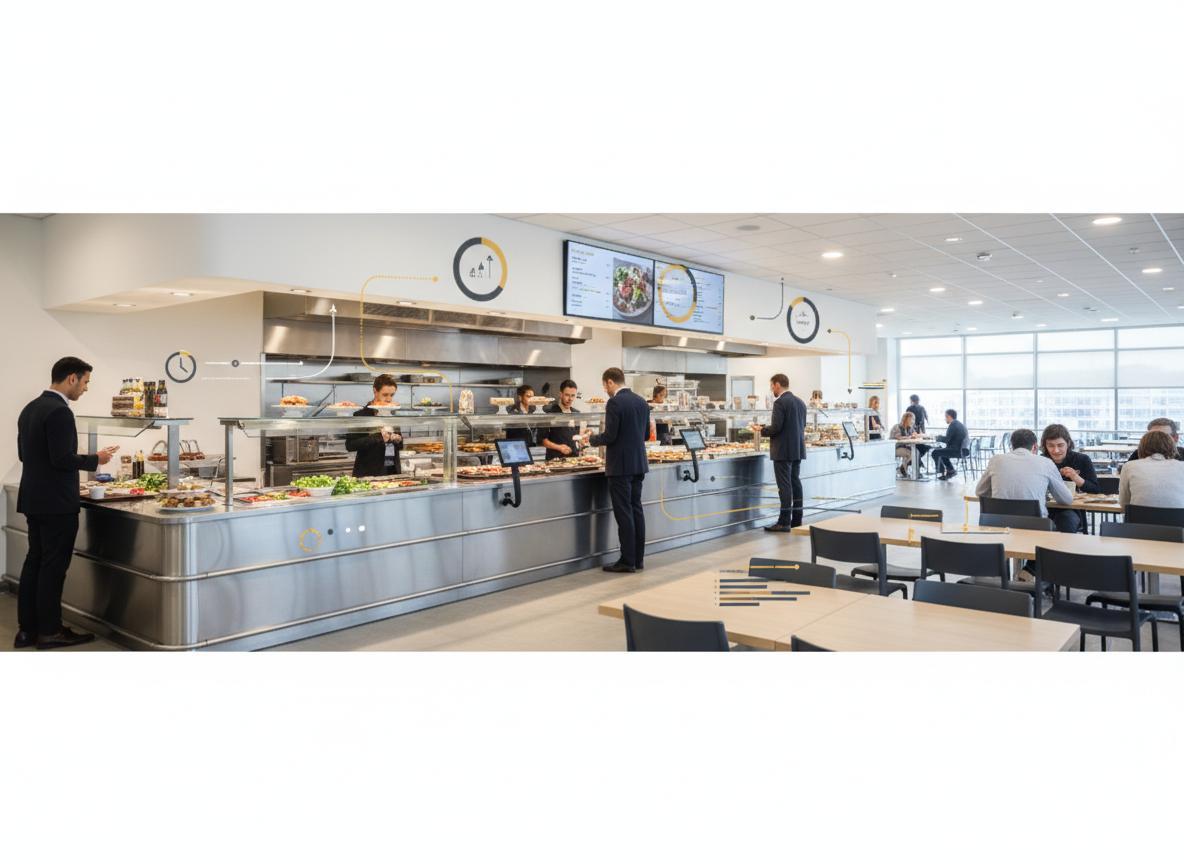
The uncomfortable truth: great food can still create a poor experience
You can have a strong culinary concept and still lose people due to:
· Long queues and unpredictable peak-time pressure
· Poor availability (popular items run out early)
· Inconsistent execution between days, sites, or teams
· Confusing pricing, unclear value, or perceived shrinkflation
· A mismatch between what people want and what is produced
· A slow feedback loop (well review it in the quarterly meeting)
None of those issues are solved by adding another salad option.
Theyre solved by seeing whats happening and acting on it.
The catering experience is a system, not a menu
A catering user experience is the combined outcome of:
· Operational reality (flow, staffing, service speed, replenishment)
· Demand patterns (attendance, peak times, preferences)
· Commercial performance (spend, mix, margin, waste)
· Perception and trust (consistency, transparency, responsiveness)
The menu is only one lever in that system.
Data is the control panel.
Why data often matters more than the offer
1) Data turns opinions into decisions
Without shared data, catering decisions become a debate:
· People are complaining more lately.
· No, its just a loud minority.
· We need more choice.
· We need lower prices.
With the right data, you can answer:
· What changed in satisfaction, and when?
· Which sites/outlets are underperforming vs. peers?
· What is the relationship between queue time and satisfaction?
· Which changes will reduce friction and improve commercial performance?
Thats the difference between reacting and managing.
2) Data creates a faster improvement loop
A good experience comes from iteration:
1. Measure what matters
2. Identify the biggest gap
3. Take one concrete action
4. Measure again
This is where CaterSurvey and CaterFlow become experience multipliers.
· CaterSurvey tells you who you are catering to, what they value, and why different groups behave differently.
· CaterFlow is the bridge between experience and operations: it fine-tunes the freeflow/self-service setup to reduce self-service time, optimize labor, and increase the average sales price per passage.
When those two perspectives come together who people are and what they expect + how the service actually performs you can design improvements that are both visible and measurable.
3) Data makes consistency possible across sites and suppliers
If you manage multiple offices, youve seen it:
· Site A is always great
· Site B has the same contract and the same concept, but feels chaotic
The difference is rarely the menu. Its execution.
Data enables benchmarking:
· Compare performance and satisfaction across sites
· Identify where the gap is operational vs. offer-related
· Build a repeatable playbook instead of reinventing the wheel
4) Data builds trust with stakeholders
Facility Managers are expected to justify decisions: budgets, supplier performance, contract renewals, and employee experience.
Data gives you boardroom-ready answers:
· Whats improving and whats not
· Where investment will have the biggest impact
· Which actions were taken and what changed after
It turns catering from a soft topic into a managed service.
What CaterSurvey measures (and why its different)
Most surveys stop at Are you satisfied? and a few open comments.
CaterSurvey is built in four levels, so you can connect satisfaction to real segments and behaviors:
1. Demographics
2. Satisfaction
3. Food profile
4. Other profiles (office profile, change profile, communication effectiveness)
The result is a unique view of the workplace food consumer:
· People who come often vs. people who dont come at all
· New employees vs. veterans
· Health-conscious profiles vs. indulgence-driven profiles
· Everyday users vs. never users (and what would actually change their behavior)
Thats what makes the data actionable: youre not optimizing for an average person that doesnt exist.
The scenario I see over and over: designing a new freeflow without knowing the users
This happens a lot when a company builds a new self-service restaurant.
The plans are often made before anyone has a clear view of who they are catering to. Sometimes sales figures are reviewed (if youre lucky). Often, the project is driven by layout assumptions and generic best practices.
And then the drawings arrive.
Scary.
Not because kitchen builders or caterers dont do good workthey do. But because without data its almost impossible to:
· Estimate how many people will choose each counter
· Predict where queues will build
· Decide what should be fast-grab vs. slower service
· Staff correctly for peak moments
· Design a freeflow that feels smooth instead of stressful
Best-practice requirements: what good looks like before you approve a freeflow
If youre a client (or a Facility Manager), you shouldnt have to hope the design will work.
A practical best practice is to ask your kitchen builder and/or caterer to provide two simple, decision-ready outputs before final approval:
1) A Flow Score (AF)
Evaluate the freeflow with a clear score based on flow KPIs such as:
· Average time in freeflow
· Queue time
· Congestion minutes (how long the area operates in a congested state)
This is not about perfectionits about making sure the design will perform under peak pressure.
2) A Dining Experience Score
Pair the flow view with a dining experience assessment based on:
· Peak concurrent seated baseline (how many people are seated at the same time during peak)
· Recommended seats (what the design should provide to avoid stress and seat hunting)
It makes the experience tangible: not just nice furniture, but whether the restaurant can actually absorb demand comfortably.
3) Multiple simulations, compared side-by-side
One simulation is a snapshot. Several simulations are a decision tool.
Running multiple scenarios and comparing them is a must to take the best decisionsbecause small layout changes can have a big impact on:
· Self-service time
· Staffing needs
· Congestion
· And ultimately, sales per passage
Why this helps kitchen builders and caterers win tenders
This approach isnt extra work. Its a competitive advantage.
When a kitchen builder or caterer can show data-backed performanceflow score, dining score, and scenario comparisonsthey reduce risk for the client.
And in tenders, reducing risk is often what wins.
Closing: the offer gets attention, data creates performance
Food is what people see.
Data is what makes the experience reliable, scalable, and continuously improving.
If you want workplace catering that people trust and usenot just a concept that looks good in a tendertreat data as a core ingredient.
See your own restaurant's flow, backed by data
ALOHA CaterFlow simulates your company restaurant so you can cut queues, remove bottlenecks and get a boardroom-ready action plan in 2–3 weeks.
Get started