Why Knowing Your Customers Matters Even More in a Company Restaurant
In a company restaurant, you serve the same people every day—so guessing isn’t a strategy. POS data shows what sold, but not what employees truly want (or why non-users stay away). By identifying your mix of Grazers, Budgeteers, Traditionalists, and Explorers, you can shape the right offer, pricing, and communication—and drive change with far less resistance.
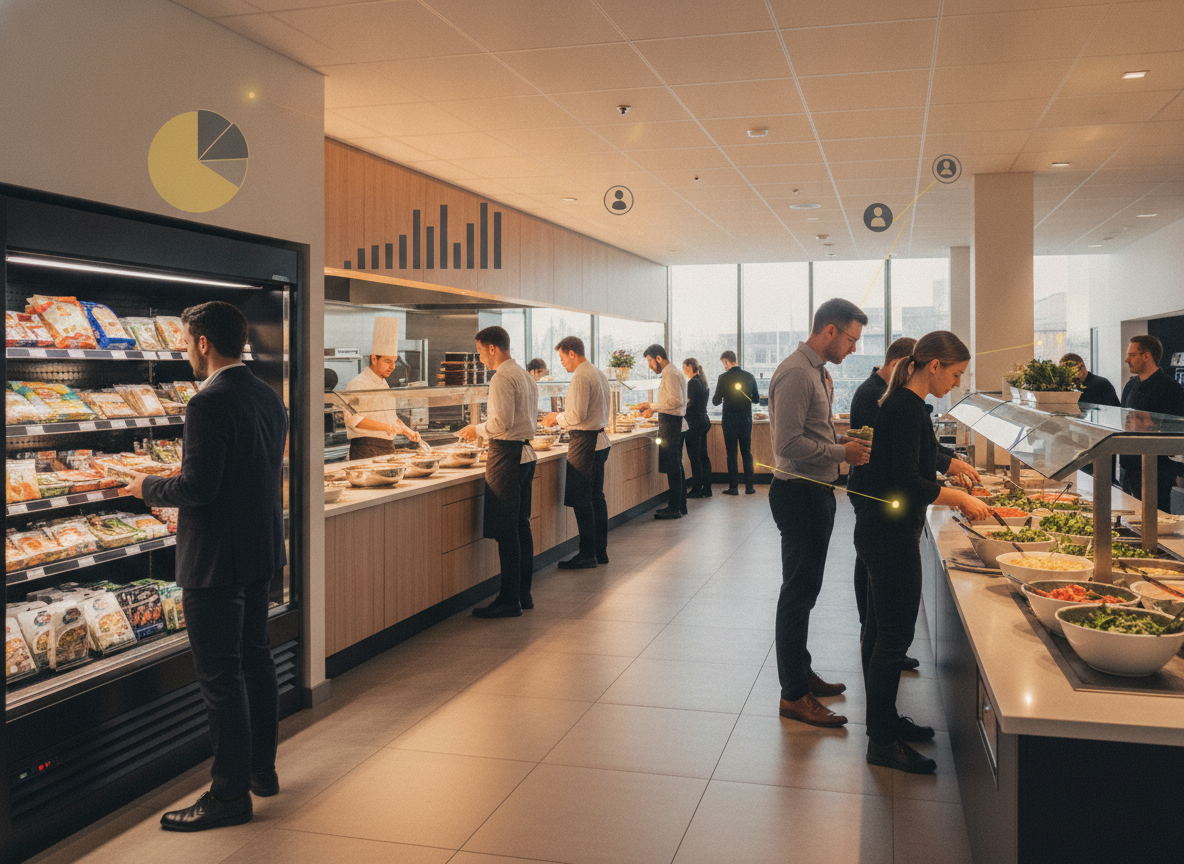
In most food businesses, customers come and go. In a company restaurant, they don’t.
Your guests are captive in the best sense of the word: you’re catering to the same people, in the same place, week after week. That changes the rules. Because when your audience is stable, “good enough” becomes visible fast—and so does missed potential.
If you want higher participation, better satisfaction, and smoother change management, there’s one lever that beats menu tweaks and marketing posters every time:
Know who your customers really are—and what they actually want.
The POS trap: what people buy isn’t the full story
Most caterers and consultants start (and often end) with POS data. Sales figures are useful, but they’re also misleading when used as the primary lens.
POS data tells you:
· What people took in a specific situation
· What sold under your current price policy
· What moved fastest given today’s layout, queue, and time pressure
But it doesn’t tell you:
· What people wanted but didn’t find
· Why they chose a product (taste, price, speed, habit, social norms)
· What non-users want (the people who avoid the restaurant entirely)
· What would happen if you changed the offer, the flow, or the pricing
In other words: POS shows behavior. It doesn’t explain motivation.
And in a company restaurant, motivation is everything—because you’re not trying to win a one-time purchase. You’re shaping a daily habit.
Four profiles that change how you design the offer
A practical way to understand your audience is to map them into four consumer profiles:
· Grazers: prefer lighter, flexible eating during the day; they value speed, snacks, extended opening, and grab-and-go.
· Budgeteers: have a fixed lunch budget and hunt for filling value; they respond strongly to pricing, bundles, and promotions.
· Traditionalists: want familiar, homemade, classic meals; they value the “plat du jour,” comfort food, and a clear meal structure.
· Explorers: want variety and discovery; they’re attracted by world cuisines, seasonal rotation, festivals, and “something new.”
The key question isn’t “Do we offer sandwiches?” but:
Do you know how many Grazers, Budgeteers, Traditionalists, and Explorers you actually have?
Because once you know the mix, you can:
· Adapt the food offer with intention (not guesswork)
· Align pricing strategy to real needs
· Design the space and flow to match behavior
· Communicate in a way that resonates with each group
Same profile, different person: segmentation goes deeper
Even within the same profile, the “why” can be completely different.
A Gen Z male Grazer and a Baby Boomer female Grazer who is health-conscious may both choose grab-and-go—but for different reasons:
· One may value speed and flexibility.
· The other may value portion control, nutrition, and ingredients.
If you treat them as the same person because they bought the same item, you’ll miss what drives satisfaction.
This is why company restaurants need behavior + context, not just sales.
Case study: the sandwich queue that lied
Here’s a classic example of why observation and POS can create false certainty.
A client was convinced that more than 30% of their consumers were Grazers—because every day there was a long queue for sandwiches.
After running a proper consumer study, the reality was different:
· Only 16% were Grazers.
· Many of the people in the sandwich line were actually Budgeteers.
They weren’t choosing sandwiches because they wanted “grazing.”
They were choosing sandwiches because the price-value equation made it the best deal in the room.
That insight changes everything.
Instead of over-investing in a “grazing concept,” the team could adjust:
· The offer architecture (what sits where, and why)
· The price policy (bundles, anchors, promotions)
· The menu strategy (value meals vs. variety vs. health)
And most importantly: they could align the restaurant with the company’s broader strategy—whether that’s well-being, sustainability, talent attraction, or cost control.
Knowing your mix makes change management easier
Company restaurants evolve: new concepts, new suppliers, new sustainability rules, new layouts, new opening hours.
Every change creates friction.
When you know your consumer profiles, you can predict impact:
· How many people will naturally support the change
· How many will resist (and why)
· What you need to communicate to bring people along
That means fewer surprises, fewer complaints, and faster adoption.
You’re no longer “hoping” the change will work—you’re managing it.
CaterSurvey: the missing layer beyond POS
This is exactly why CaterSurvey exists.
It’s designed to tell the story that POS can’t:
· Your real consumer profile mix (Grazers, Budgeteers, Traditionalists, Explorers)
· What non-users want (and what’s blocking them)
· Deeper segmentation, including office profile and change profile
· How to communicate effectively to each group
In a captive environment, that’s not a “nice to have.” It’s the foundation of a restaurant strategy that performs.
The takeaway
If you manage a company restaurant and you’re only looking at sales figures, you’re seeing the outcome—but not the drivers.
When you understand who your customers are, you can:
· Build an offer that fits real needs
· Set pricing that supports both value and strategy
· Communicate in a way that lands
· Drive change with less resistance
Because in a company restaurant, you’re not serving “customers.”
You’re serving your people—every day.
See your own restaurant's flow, backed by data
ALOHA CaterFlow simulates your company restaurant so you can cut queues, remove bottlenecks and get a boardroom-ready action plan in 2–3 weeks.
Get started